Hey there, Michigan. It’s Hayley.
As those who have been around a while (two weeks) may recall, Votebeat launched a pet election earlier this month. In contention are my two perfect rescue bunnies, Honey and Puff, and also a beautiful menagerie of cats and dogs who live with my colleagues.
As a subscriber to this newsletter, you get to vote in this election. Your ballot is linked below. But! Before you scroll down! It’s worth considering how you’ll vote.
The thing about our pet election is that it’s actually two: There’s a plurality election (i.e., whichever pet claims the most votes overall wins, even if no one claims a majority) and also a ranked choice election. When you fill out your ballot, you’ll vote in both.
I campaigned hard to have Puff and Honey, who are siblings, a bonded pair, and generally best friends, included as a single candidate. This, to me, makes a lot of sense. They can’t go to the vet in separate carriers, so why should we separate them as candidates? Alas, I was overruled on that one.
So instead of having one easy choice of rabbits all the way down the ballot, you unfortunately have to pick a top hopper. This, at its core, is the entire point of ranked choice voting.
Rabbit choice voting
To make this a metaphor: Say you’re a proud member of the Bunny Party. You can certainly support some viewpoints of another party — maybe you think that the Dog Party makes a great point about Going Outside To Play, for instance, while the Kitty Committee has brought up some valid concerns about the timing of meals at home — but ultimately your heart lies with the Bunnies. The ranked choice ballot makes it easy to represent that in a race with a bunch of candidates.
In this hypothetical race, you get to pick your top rabbit choice. But you can also use your ballot to signify that even if that specific bunny did not win, you are still firmly in the Bunny camp! To do that, you’d rank the other bunny candidate No. 2.
From there, you can express your preference all the way down. Maybe you love a certain cat candidate. If the bunnies don’t take it all, you wouldn’t be too mad to see that cat as a next choice. Then maybe you rank a cute dog that looks like your childhood pet, followed by another sweet kitty. And so on and so forth. (In our pet election, you must fill out the entire ballot, but in most ranked choice races, you can stop ranking when you’ve run out of candidates you support.)
Votes are also counted differently in ranked choice elections. Ballots are tallied in rounds until someone has at least 50% of the vote. The first round considers everyone’s top choice, giving a percentage of overall ballot share to every single candidate. The lowest vote-getter is then eliminated from contention.
For those who voted for that candidate, their second choice is then considered, and the numbers are re-run. This process of elimination, re-tabulation, rinse and repeat, continues until there’s a majority winner.
It can be an interesting option in races with a lot of candidates, like a primary race in a city that has single-party dominance, or in a gubernatorial campaign with a candidate that has broken from his original party and is instead courting votes statewide as an independent. (Ahem.)
As I’ve reported, Rank MI Vote, the effort to enshrine ranked choice voting in the state’s constitution, is collecting signatures throughout Michigan. If they get enough, voters will decide whetherMichigan will become the most populous jurisdiction in the country to use it. But it’s not without challenges — Republicans in the House are seeking to ban ranked choice voting at a legislative level, and early polls show it’s unpopular with the general public.
If you haven’t participated in ranked choice voting before, you can feel it out in our pet election. As promised, here’s that ballot. This form will only be shared with newsletter subscribers, so please don’t share the link. We’re serious about election security — if anyone votes who isn’t signed up for a Votebeat newsletter, their ballot will be thrown out.
And if you know someone who’s passionate about voting methods and/or Votebeat staff pets, they can sign up for the newsletter here to participate.
Speaking of, here are my beloved candidates now:
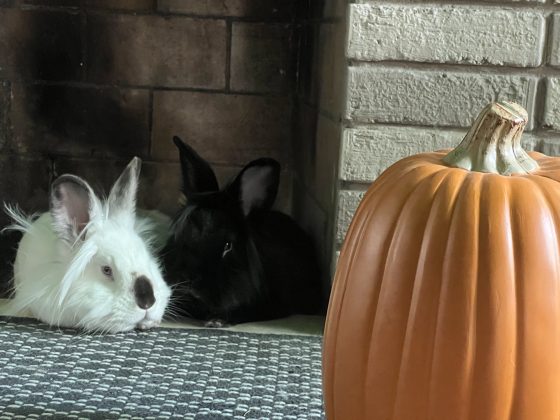
All seasonal decorations will be CLOSELY monitored under the watchful eye of the Bunny Party.
|
You’re invited
On Friday (that’s tomorrow) at 12 p.m. EDT, join us for a conversation on public trust in elections with an elections expert and two experienced election officials. Moderated by Votebeat Editorial Director Jessica Huseman, the panel will cover the state of public trust in elections and the factors that influence it.
Our panelists are:
- Charles Stewart III, Kenan Sahin Distinguished Professor of Political Science at MIT
- Seth Bluestein, Philadelphia City Commissioner
- Karen Brinson Bell, former executive director of the North Carolina State Board of Elections
Save your seat for free right here!